Meiosis 1 Y 2 Biology Diagrams The diagram of meiosis is beneficial for class 10 and 12 and is frequently asked in the examinations. The diagram of meiosis along with the explanation of its different stages is given below in detail. Further Reading: Meiosis II. Significance of Meiosis. Meiosis I. Well-Labelled Diagram for Meiosis. Meiosis I Prophase I. Here, the chromosomes Meiosis 1 vs. Meiosis 2 Venn Diagram. Meiosis is the process by which sex cells (eggs and sperm) are produced. It involves two rounds of cell division, known as meiosis 1 and meiosis 2. A Venn diagram can be used to compare and contrast the two stages of meiosis. Definition and Example of "Meiosis 1 vs. Meiosis 2 Venn Diagram" As seen in the diagram of meiosis, it is a two-step process in which cells are divided, called meiosis I and II. The cytoplasmic division is part of every step in the process. Meiosis I and meiosis II each have the following 4 steps: Prophase, metaphase, anaphase, telophase, and cytokinesis.

A diagram showing the different stages of the process of meiosis. Definition. Meiosis is a type of cell division occurring only in sex cells or gametes (such as spermatozoa and ova) that involves a single parent cell dividing to produce four daughter cells. These are genetically different and each of the daughter cells having half of the number of chromosomes of the parent cell (this is the The Phases of Meiosis II. Meiosis II may begin with interkinesis or interphase II. This differs from interphase I in that no S phase occurs, as the DNA has already been replicated. Thus only a G phase occurs. Meiosis II is equational division, as the cells begin as haploid cells and end as haploid cells. There are again four phases in meiosis

Meiosis in a Cell: Stages, Phases of Meiosis 1 and 2 with diagrams Biology Diagrams
Phases of Meiosis There are two divisions in meiosis; the first division is meiosis I: the number of cells is doubled but the number of chromosomes is not. This results in 1/2 as many chromosomes per cell. The second division is meiosis II: this division is like mitosis; the number of chromosomes does not get reduced. The phases have the same
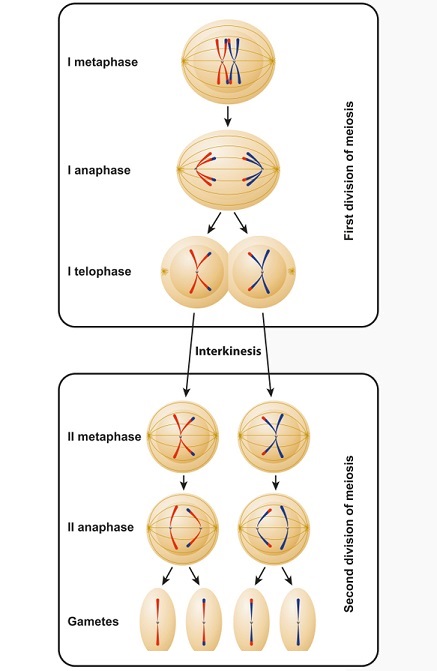
Meiosis is a form of cell division that usually occurs only once in the lifetime of a eukaryote, and is vital to the sexual reproduction of eukaryotic organisms. Meiosis forms gametes, or sex cells, by rearranging and mixing genetic material, which ensures genetically-distinct progeny (children) and sufficient variety in the gene pool.. Because meiosis begins with one diploid parent cell and Chromosome Alignment and Separation in Meiosis I vs. Meiosis II. The process of chromosome alignment and separation differs significantly between Meiosis I and Meiosis II. Understanding these differences is crucial to grasp the mechanics of meiosis and how it contributes to genetic diversity. Let's break it down phase by phase: